
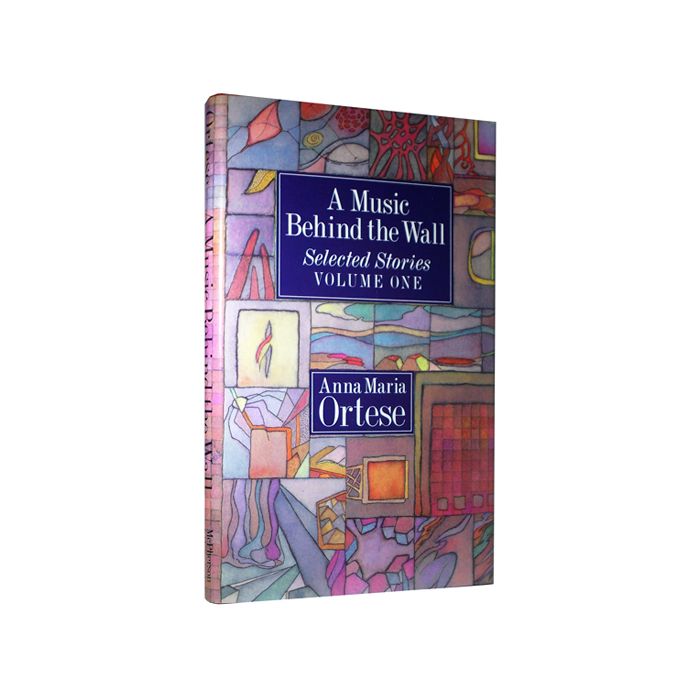
Music Behind The Wall: Volume One
In her lifetime, Anna Maria Ortese received virtually every major Italian literary award, and, in a career spanning six decades, her last works became Italian bestsellers. Those who have read The Iguana know what extraordinary mysteries of human conscience and compassion Ortese's writings plumb. For several years we planned a fuller presentation of her work, selecting twenty stories from her many collections. These are published in two volumes, translated and introduced by the distinguished editor of our Italian series, Henry Martin. The first volume contains stories ranging in style and mode, from realistic to the frankly visionary. Yet, for all their variety, there is a steadfastness and coherency to Ortese's tales, and something original and almost entirely foreign to American writing. Can it be quite simply this: a conviction, verging upon certitude, of the validity, even necessity, of coincident or converging realities? To read one of Ortese's stories, which are almost impossible to describe in ordinary terms, is to tap into an unexplained circumstance, truly a condition of suspended disbelief, and to hear a voice by turns disquieting and strangely reassuring. Translated from the Italian by Henry Martin.
| Weight | 0.375000 |
|---|---|
| ISBN13/Barcode | 9780929701394 |
| ISBN10 | 0929701399 |
| Author | ORTESE Anna Maria |
| Binding | Hardback |
|---|---|
| Date Published | 12th March 1998 |
| Pages | 160 |
| Publisher | McPherson & Company,Publishers |
In her lifetime, Anna Maria Ortese received virtually every major Italian literary award, and, in a career spanning six decades, her last works became Italian bestsellers. Those who have read The Iguana know what extraordinary mysteries of human conscience and compassion Ortese's writings plumb. For several years we planned a fuller presentation of her work, selecting twenty stories from her many collections. These are published in two volumes, translated and introduced by the distinguished editor of our Italian series, Henry Martin. The first volume contains stories ranging in style and mode, from realistic to the frankly visionary. Yet, for all their variety, there is a steadfastness and coherency to Ortese's tales, and something original and almost entirely foreign to American writing. Can it be quite simply this: a conviction, verging upon certitude, of the validity, even necessity, of coincident or converging realities? To read one of Ortese's stories, which are almost impossible to describe in ordinary terms, is to tap into an unexplained circumstance, truly a condition of suspended disbelief, and to hear a voice by turns disquieting and strangely reassuring. Translated from the Italian by Henry Martin.
"The stories demonstrate an attractive, humane voice and a magical ability to make meaning and myth of daily existence. . . . They make up a weird and atmospheric collection that is impossible either to summarize or to put down." — Booklist
"Like the best supernatural writers, Ortese understands that what distinguishes the genre is the fear that our nervous forebodings are not reducible to inner trauma and turmoil. To conceive of the ghost story purely as a battle with psychological demons, however terrifying they may be, is to denature it. Ortese takes her spirits very seriously, so much so that the haunted narrator in "The House in the Woods" can't tell whether she's dreaming or awake -- she eats a page of Kant out of sheer bewilderment . . . The horror, and beauty, of Ortese's writing hinges on the issue of externality: the fear of something out there that is not oneself, something wholly independent of one's wishes and feelings." — Bill Marx, Boston Phoenix