
Aeschylus' Agamemnon in Scots
Transforming Aeschylus’ timeless epic Agamemnon into Scots, this groundbreaking translation transports readers into the heart of ancient Greece, infusing the classic tale with the lyrical beauty and cadence of the Scots language.
William Imray’s masterful rendition captures the essence of the original while breathing new life into the narrative, making it accessible to modern audiences and lovers of Scots literature alike.
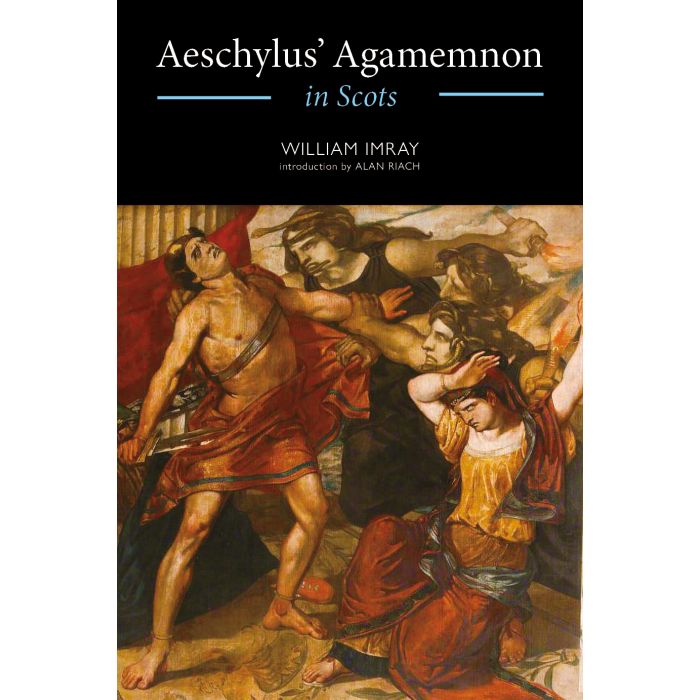
Aeschylus’ Agamemnon depicts king Agamemnon’s return from the Trojan War and his murder by his wife, Clytaemestra, as revenge for sacrificing their daughter, Iphigenia. The play explores themes of justice, revenge and the cycle of violence within the House of Atreus, laying the groundwork for the subsequent plays in the Oresteia trilogy. It marks a significant evolution in Greek drama, reveals the fundamental origins of western democracy and is one of the greatest works in world literature.
| Weight | 0.280000 |
|---|---|
| ISBN13/Barcode | 9781804251607 |
| ISBN10 | 1804251607 |
| Author | William Imray |
| Binding | Paperback |
|---|---|
| Date Published | 1st October 2024 |
| Pages | 191 |
| Publisher | Luath Press |
About the Book:
Imray has taken immense care to use the same metre as one finds in the original Greek. To my ears, English does not lend itself so readily to this priority. Scots does. When I compare Imray’s translation with those of others, and make comment about its pace, rhythm and timbres, its tones and colours, the distinction I’m referring to is directly drawn from Aeschylus. From the introduction by ALAN RIACH
Transforming Aeschylus’ timeless epic Agamemnon into Scots, this groundbreaking translation transports readers into the heart of ancient Greece, infusing the classic tale with the lyrical beauty and cadence of the Scots language.
Ann sàe I wàtch yet, wỳtinn àye that sìgnal’s lìcht,
a blèezinn lòwe tae brìng us nèws awàa frae Tròy,
repòort o ’ts càptur. Wèill, ’t’s sae shè’s commàndit mè,
this dème wi mànlike plòys and mànlike hòpes they’ll thrìve.
William Imray’s masterful rendition captures the essence of the original while breathing new life into the narrative, making it accessible to modern audiences and lovers of Scots literature alike.
Aeschylus’ Agamemnon depicts king Agamemnon’s return from the Trojan War and his murder by his wife, Clytaemestra, as revenge for sacrificing their daughter, Iphigenia. The play explores themes of justice, revenge and the cycle of violence within the House of Atreus, laying the groundwork for the subsequent plays in the Oresteia trilogy. It marks a significant evolution in Greek drama, reveals the fundamental origins of western democracy and is one of the greatest works in world literature.
Reviews:
This is a magnificent achievement, William Imray’s translation, Alan Riach’s Introduction, and Luath Press, to bring it to fruition. And as we’ll all agree, Aeschylus’ in the first place. I hope it reaches receptive readers and listeners – and theatre folk. How wonderful it will be to see-and-hear it staged.
ADRIAN POOLE, Professor Emeritus, Faculty of English, University of Cambridge
One can’t deny that Aeschylus was a brilliant playwright. EMMA BERGE, British Theatre Guide on Aeschylus
If it cannot be proved that Aeschylus ‘invented’ tragedy, it is clear that he at least set its tone and established a model that is still operative. BRITANNICA on Aeschylus